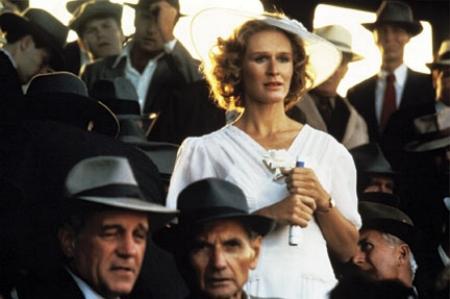
We have another Sunday morning game after a soggy Saturday that rained out play at Fairmont. While no rain was falling, the Smith Park grounds were riddled with puddles, and damp where there was no standing water. Conditions were less than ideal, but it was dry enough to chalk the lines on the asphalt. Three whifflers met at nine: Ben, Stats, and the Commish. So once again it would be 1 on 1 on 1.
The early rounds went to da Commish as he followed a lead-off triple with a prodigious 2-run home run off Ben. Ben would find sweet revenge though, peppering five straight hits off Stats (4 singles, then a double) to plate three, exploding Lindsay’s heretofore unblemished ERA.
Like the roiling sky above, all was gloomy for Stats. Completely shut down by Peter in two rounds, he came to the plate to face Ben. Stepping into the batter’s box (long since washed away by Peter’s incessant “digging in”), Stats brought Ben’s wind-up into focus. But what did he happen to see just over Ben’s right shoulder.. just beyond the chain link fence.. standing there on Aberdeen Avenue? Could that be? It was. The former Karen Ruth Lavy – Stats’ bride of 16 years!
And as she befigured a modern Iris Gaines, the effect was felt by all in three consecutive at bats. Single! Home Run! HOME RUN!
Da Commish would hit one more “big fly,” this one off Stats, and the final would be an unsatisfying 3 to 3 to 3. And as the precedent had been set, the “stats” (if you can call what you get from this glorified batting practice “statistical”) do count. Thus only five remain with ERAs of zero. All who played today saw their batting averages inflated, RBI totals padded. But for one, it was a day of Whiffle Magic.
Showing posts with label Montague. Show all posts
Showing posts with label Montague. Show all posts
Sunday, May 2, 2010


Wednesday, April 28, 2010
The History of W(h)iffle Ball
While the exact origins of W(h)iffle ball are unknown, most historians agree that it is based on the Aztec pastime qixtaxijhal, a game which came north with itinerant fruit pickers in the early 19th century. Originally played with the hollowed out head of a sacrificial child and the femur of a mountain goat, by the time the game reached the U.S. a dried orange and balsa wood bat had been substituted. Throughout the early decades of the 19th century, small towns formed teams, and what came to be known as W(h)iffle Ball clubs sprang up in the larger cities. In 1845, Linus Steptoe, a rakish mountebank and sometime-salesman of unguents and gluten-based analgesics, wanted to formalize a list of rules by which all the teams could play. Much of the original code is still in place today, though certain modifications have since occurred.
The first recorded W(h)iffle Ball contest took place a year later in 1846. Steptoe and his Swat-King club of New York City lost to The Hackensack Highlanders in a game at the Eden Fairgrounds in Bayonne, New Jersey. In 1857, a convention of W(h)ifflers, as they were now known, met to discuss rules and the formation of a league. Twenty-Five teams from the Northeast and Midwest sent delegates. The following year they formed the Midwestlantic Association of W(h)iffle Ball Clubs. In its first year of operation, the league supported itself by charging either two cents, or an egg, for admission to games. The future looked bright.
Although the league was supposed to be comprised of amateurs, many players were secretly paid, in either eggs, or a sorghum flavored chew, which was said to promote gastro-intestinal health. In 1869, the Dayton Recliners (so-called for their tendency to sit on stools or large stones set next to the batters box) became the first professional team. The idea of paid players quickly caught on and before long professional teams dotted the map. The country, prosperous and peaceful throughout the remainder of the century, quickly embraced the league and a deep and abiding love affair thus began. By 1899, there were literally thousands of teams, some seeming to spring up overnight, like mushrooms or mold.
Professional W(h)iffle Ball was built on the foundation of the amateur leagues that preceded it. Interest in the game as a spectator sport had been nourished for more than a quarter of a century. It’s great attraction to the public was two-fold. It required no discernable skill or thought and it promoted the sedentary lifestyle popular with the working classes of the day.
Throughout the first decade of the 20th Century, W(h)iffle Ball remained a game of strategy. The so-called “dead-orange” provided few homeruns. The game relied on contact pitching and horrible fielding for its offense. The adoption of Edison’s celluloid ball and bat in 1911 changed the game dramatically. The popularity of W(h)iffle Ball exploded, but tensions did as well. Rival leagues formed and folded and the practice of luring players from one league to another with increased egg and sorghum allocations reached crisis proportions. Eventually, the supreme court stepped in to rule that the game was exempt from anti-trust legislation and the age of the W(h)iffle Barons commenced.
The Roaring Twenties were the best and worst of times for the game. Scandals rocked the league and gambling was ubiquitous, but the stands remained largely filled and the coffers overflowed. In 1921, the young W(h)iffle phenom, George Herman “Babe” Ruth, left the league to play a new game called “Baseball”. Ruth had astounded the fans with his eight foot curve-balls and his rabbit like defense. His called shot of 1918 sated a nation, war-weary and starved for leisure. His departure was an ill omen for the national pastime.
More and more players left the league in the 30’s and 40’s for the relatively safe pleasures of “baseball”, “shuffle-board” or “jacks”. By the 1960s the game was largely forgotten and throughout the remainder of the century was played mostly behind old warehouses by meth addicts and hoboes.
In 2006, behind the leadership of three wily tribesmen: Ben “Feh” Montague, Brian “Zaydie” Simpson and Glen “The Macabee” Cebulash, a small upstart was league was formed on the hallowed asphalt of Smith School Playgrounds. Unbeknownst to the three intrepid “menschen”, the elementary school had been built upon the very ground where once the mighty Recliners had sat. In 2008, the philosopher barrier was broken when the Kantian Kurt Mosser categorically joined the league and the Republican barrier was dismantled the following year with the inclusion of Dave Eldridge.
Subscribe to:
Posts (Atom)

 Posts
Posts